Key Takeaways
- Inclusive education begins with shared beliefs, not isolated strategies.
- Educators, support staff, and school leaders share responsibility for every student.
- School leaders must create the conditions for meaningful collaboration.
- Inclusive mindsets influence instruction, policies, programs, and resource decisions.
- Authentic Inclusive practices require sustained reflection, action, and accountability.
Why Shared Practice Begins With Shared Thinking
Inclusive education is a practical, achievable commitment to ensuring every student belongs, participates, and receives the support they need to thrive. Inclusive schools are not built through isolated strategies. They grow from a shared understanding of who holds responsibility and how the school community works together to support every learner.
Schools often begin their inclusion efforts with a practical question: What should educators do differently? That question matters, but lasting change begins one step earlier. School communities must first examine the beliefs, assumptions, and language that shape everyday decisions. Teachers bring those beliefs into classroom practice, while administrators reinforce them through policies, staffing, professional development, resource allocation, and schoolwide expectations.
A new strategy may change what happens in one classroom for a day. A shared mindset can transform how educators, support staff, and school leaders make decisions across classrooms, programs, and school years.
Changing Perspectives utilizes the Inclusive Mindsets Framework to help schools build that foundation. Eight principles give educators a common lens for understanding inclusion, recognizing differences, and embracing shared responsibility for every student.
Rather than prescribing a single program or collection of classroom activities, the framework strengthens the thinking behind inclusive education. When educators share a mindset, inclusion becomes more than an abstract goal. It becomes a consistent way of approaching relationships, instruction, collaboration, and schoolwide decision-making.
Eight Principles That Shape Inclusive Communities
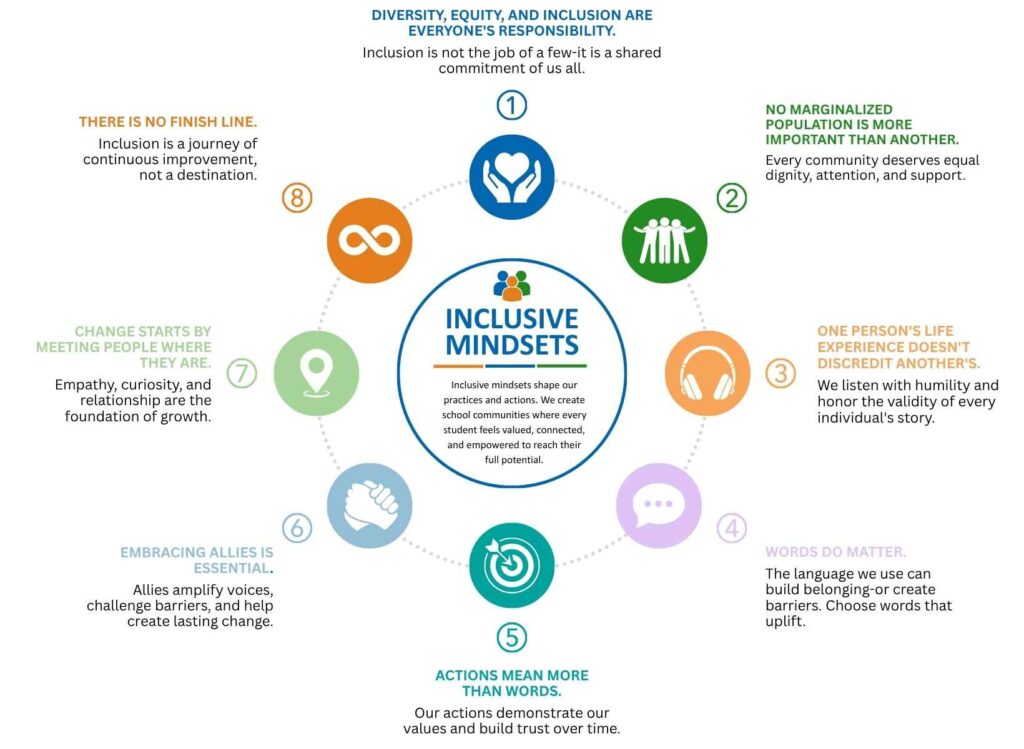
The Inclusive Mindsets Framework centers on eight guiding principles:
- Diversity, equity, and inclusion are everyone’s responsibility.
- No marginalized population is more important than another.
- One person’s life experience doesn’t discredit another’s.
- Words do matter.
- Actions mean more than words.
- Embracing allies is essential.
- Change starts by meeting people where they are.
- There is no finish line.
Together, these principles invite educators to look beyond individual strategies and examine the beliefs that shape everyday choices. They encourage school communities to ask deeper questions about belonging, participation, and responsibility.
Who is recognized as a full member of the classroom and school community? Who is encouraged and expected to participate? When a student struggles, do educators view the student as the problem, or do they examine the learning environment, expectations, and available supports? Do school policies, schedules, staffing structures, and resource decisions support inclusion or create additional barriers? Does responsibility for inclusion fall primarily to specialists, or does the entire school community embrace it as a shared commitment?
These questions rarely lead to simple answers. They may challenge long-standing assumptions, reveal gaps between intentions and actions, and require educators to reconsider familiar practices. That complexity makes a common framework especially valuable. It gives school communities a shared starting point for reflection, honest conversation, and meaningful change.
 \
\
Download the Inclusive Mindsets Framework
Inclusive Mindsets Shape Practices and Actions
Inclusive mindsets sit at the center of the framework because the beliefs people hold shape the practices they adopt and the actions they take. When school communities put the eight principles into practice, they help create schools where every student feels valued, connected, and empowered to reach their full potential.
Those beliefs become visible through everyday decisions. Students experience a school’s mindset through the words adults choose, the expectations educators hold, the spaces students enter, and the opportunities they receive to learn, participate, and contribute. Schoolwide decisions involving placement, discipline, instructional practices, schedules, extracurricular activities, and support services communicate those beliefs as well.
For that reason, good intentions alone cannot create an inclusive school. School staff may genuinely value every student while maintaining classroom practices or school systems that unintentionally separate, restrict, or exclude some learners.
The Inclusive Mindsets Framework helps school communities recognize and close the gap between their stated values and their actions. It invites educators to examine whether their practices and decisions consistently reflect what they believe about inclusion.
Turning Theory Into Practice at Del Mar Middle School
Changing Perspectives used the Inclusive Mindsets Framework as part of its sustained partnership with Del Mar Middle School. The Del Mar Middle School case study provides an overview of the school’s goals, the support provided, and the outcomes of that work.
Educators examined ableism, asset-based and deficit-based thinking, growth mindset, and the social and medical models of disability. Exploring these concepts gave staff a shared language for discussing student needs while also considering the assumptions, expectations, and systems that shape students’ experiences.
Rather than treating the framework as a one-time exercise, Changing Perspectives reinforced its principles through professional development, site visits, coaching, and ongoing opportunities for reflection and application. Del Mar sustained that work through a multiyear partnership rather than limiting it to a single training session.
That sustained approach helped staff connect shared mindsets to daily practice. Conversations about inclusion informed assessment design, classroom access, educator collaboration, student belonging, and the district’s push-in model. Staff identified practical ways to make their existing work more inclusive. Their experience shows school communities that meaningful progress can begin within existing classrooms, programs, and systems rather than waiting for a perfect program or complete overhaul.
The article What Sustained Partnership Makes Possible: Lessons From Del Mar Middle School explores how ongoing support systems, coaching, reflection, and collaboration helped the school move from shared ideas toward sustained practice.
The partnership did not end with a declaration that the work was complete. One of the framework’s central principles recognizes that inclusion has no finish line. At Del Mar, it became an ongoing process of identifying barriers, listening to students, questioning established practices, and determining what the school community could improve next.
Moving From “My Students” to “Our Students”
One outcome of developing shared inclusive mindsets is a shift in how school communities understand responsibility for students. Over time, educators can begin moving from the language and thinking of “my students” and “your students” toward a shared commitment to “our students.”
“Inclusion grows when school communities move beyond ‘my students’ and ‘your students’ and embrace a shared belief: all students are our students.”
— Sam Drazin, Changing Perspectives, Founder and Executive Director
In many schools, responsibility for students becomes divided by classroom, program, professional role, or eligibility status. Educators may refer to “my students” and “your students” without intending to exclude anyone. Yet those familiar phrases can reveal a deeper separation in how a school understands, supports, and includes its students.
That shift reaches far beyond vocabulary. It reflects a shared belief that every student belongs to the entire school community and that educators, support staff, and school leaders all contribute to creating access, meaningful participation, and a genuine sense of belonging.
With that understanding, collaboration becomes more purposeful. General and special educators can combine their expertise to pursue common goals. Student needs no longer rest primarily with one teacher, specialist, or department. Instead of focusing on where a student is assigned or who is responsible, educators can ask a more productive question: What can we do together to help this student learn, contribute, and thrive?
Administrators turn that shared responsibility into daily practice by giving educators time to collaborate, setting clear schoolwide expectations, and ensuring systems support rather than separate students. Without those conditions, even committed educators may struggle to translate an inclusive mindset into consistent action.
When educators, support staff, and school leaders embrace every learner as one of our students, inclusion becomes a schoolwide commitment rather than an individual assignment.
A Foundation for Lasting Change
Schools do not become inclusive simply by adopting new terminology, introducing a strategy, completing a single professional development session, or adding inclusion to a strategic plan. Lasting change takes shape when educators, support staff, and school leaders examine their assumptions, commit to shared principles, and allow those principles to guide instruction, collaboration, policies, and leadership decisions.
The Inclusive Mindsets Framework gives school communities both a meaningful starting point and an enduring lens for growth. As student needs, educational practices, and school environments evolve, educators can return to the framework to reflect, realign, and determine their next steps.
The most important questions, then, are not simply: Which inclusive strategy should teachers try? Which new initiative should administrators adopt?
They are: What do we believe about who belongs here? Do our classrooms and school systems reflect that belief? What will we do together to close the gaps?